There’s a moment a lot of women describe at some point in their thirties — not panic, exactly, but a noticing. You’re getting ready one morning and something about the light, the angle, the way your skin holds a crease that wasn’t quite there before, and you think: when did this start? You go over your routine in your head. You’re consistent. You’ve invested in decent products. And yet the change is there, quietly accumulating, and your skincare shelf doesn’t seem to have an answer for it.
I know this feeling. And I want to offer you something that most skincare content won’t — an explanation that doesn’t start with a product.
A lot of what happens to skin after 30 doesn’t actually begin on the skin. It begins in the gut. Not in a vague “gut health is everything” way, but in a specific, documented, biological way that researchers have been mapping out for years. When you understand what’s actually happening, the changes you see in the mirror start to make a different kind of sense — and so do the habits that can genuinely slow them down.
What Changes in Your Gut After 30 — And Why Your Skin Pays for It
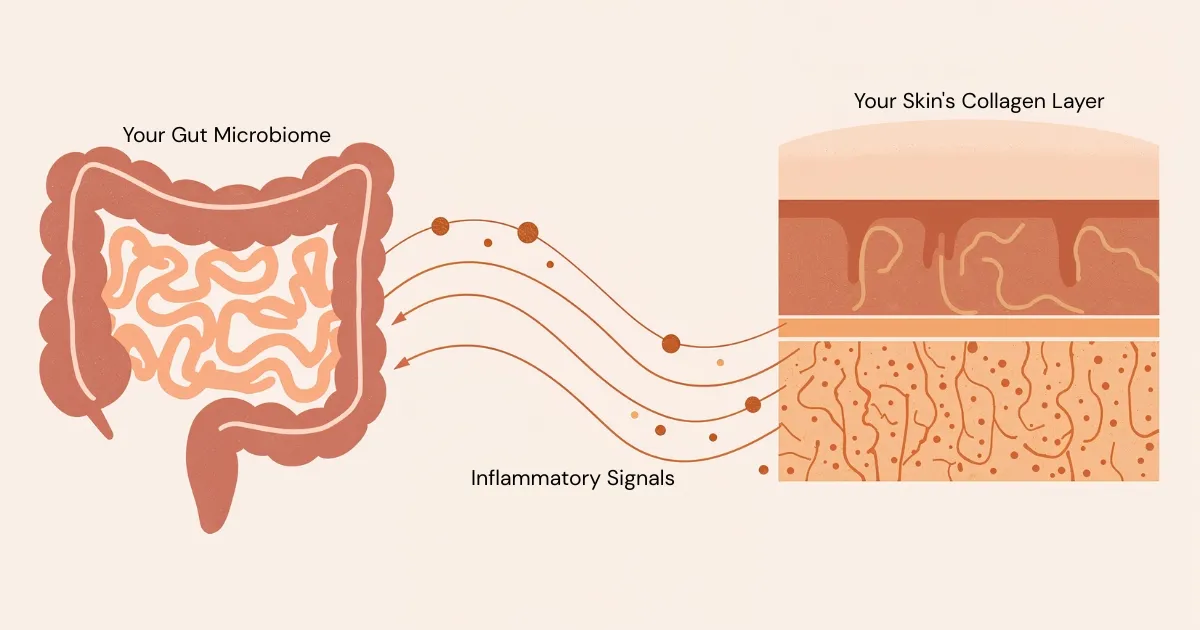
Your gut is home to trillions of microorganisms — bacteria, fungi, and other microbes that make up what researchers call the gut microbiome. These aren’t just passive bystanders in digestion. They regulate inflammation throughout the entire body, produce compounds that support your skin barrier, and help absorb the nutrients your skin needs to repair and renew itself overnight.
Here’s what becomes relevant after 30: the microbiome changes with age. A comprehensive review published in Life in 2022 documented how adults experience a gradual decline in microbial diversity, with a shift in the balance between beneficial and less beneficial bacterial populations. The bacteria that produce short-chain fatty acids — the compounds that essentially keep gut inflammation under control — become less abundant over time. Meanwhile, the gut lining can become more permeable, allowing inflammatory signals to enter the bloodstream at low, continuous levels.
And those signals don’t stay in the gut. They travel — and one of the places they make themselves known is the skin.
The skin doesn’t process inflammation quietly. It shows it. Dullness, loss of firmness, slower repair, increased sensitivity — these aren’t random signs of “just getting older.” For many women, they’re downstream effects of a gut environment that has gradually become more inflammatory with age.
Here’s what I find genuinely encouraging about this: the gut is one of the most responsive systems in the body. It responds to what you eat, how you manage stress, how consistently you sleep. Which means the things making it more inflammatory are largely the same things you can change.
How a Struggling Gut Speeds Up the Breakdown of Collagen
Collagen is the protein that keeps skin firm, smooth, and structurally intact. You’ve probably read that collagen production declines with age — and that’s true. What’s less often explained is how gut dysfunction accelerates that process.

When the gut microbiome is out of balance — a state called dysbiosis — it triggers the production of pro-inflammatory compounds: cytokines, and a family of enzymes called matrix metalloproteinases (MMPs). In plain terms: these enzymes break down collagen and elastin at a systemic level. Not because aging made it inevitable, but because chronic, low-grade inflammation signaled for it.
A 2024 study in the International Journal of Molecular Sciences found something that I think puts this in striking perspective: the skin microbiome alone could predict a person’s biological age with a mean error of just 3.8 years. That means how your skin looks and functions reflects your gut age more than it reflects your birth year. The researchers identified gut-driven inflammation as a central mechanism in this relationship.
The topical implication here is important. No serum or moisturizer can interrupt an MMP cascade that’s being triggered from inside the gut. That’s not a criticism of skincare — a good routine has real value, especially for barrier protection and hydration. But it’s working around a source of damage it simply cannot reach. Think of it this way: you can keep repainting the fence, or you can fix the moisture problem that’s causing it to peel in the first place.
There’s also a nutrient absorption piece that rarely gets discussed. A compromised gut lining is less efficient at absorbing vitamins A, C, and E, zinc, and omega-3 fatty acids — all of which skin depends on for collagen synthesis, repair, and barrier integrity. These deficiencies don’t show up dramatically in a blood test. They accumulate slowly, and the skin quietly wears them.
If this topic resonates with you, I share more in my weekly newsletter — gut-skin science I’m reading, what’s actually moving the needle, and how it connects to what you’re seeing in your skin. Sign up here — no spam, unsubscribe anytime.
The Gut Habits That Research Actually Backs
This is the part where I want to be careful. When you search for “gut health habits,” you get long lists of things you’re supposed to eat, take, and avoid — and most of it is presented as if it all matters equally. It doesn’t. Here’s what the research actually points toward for skin specifically.
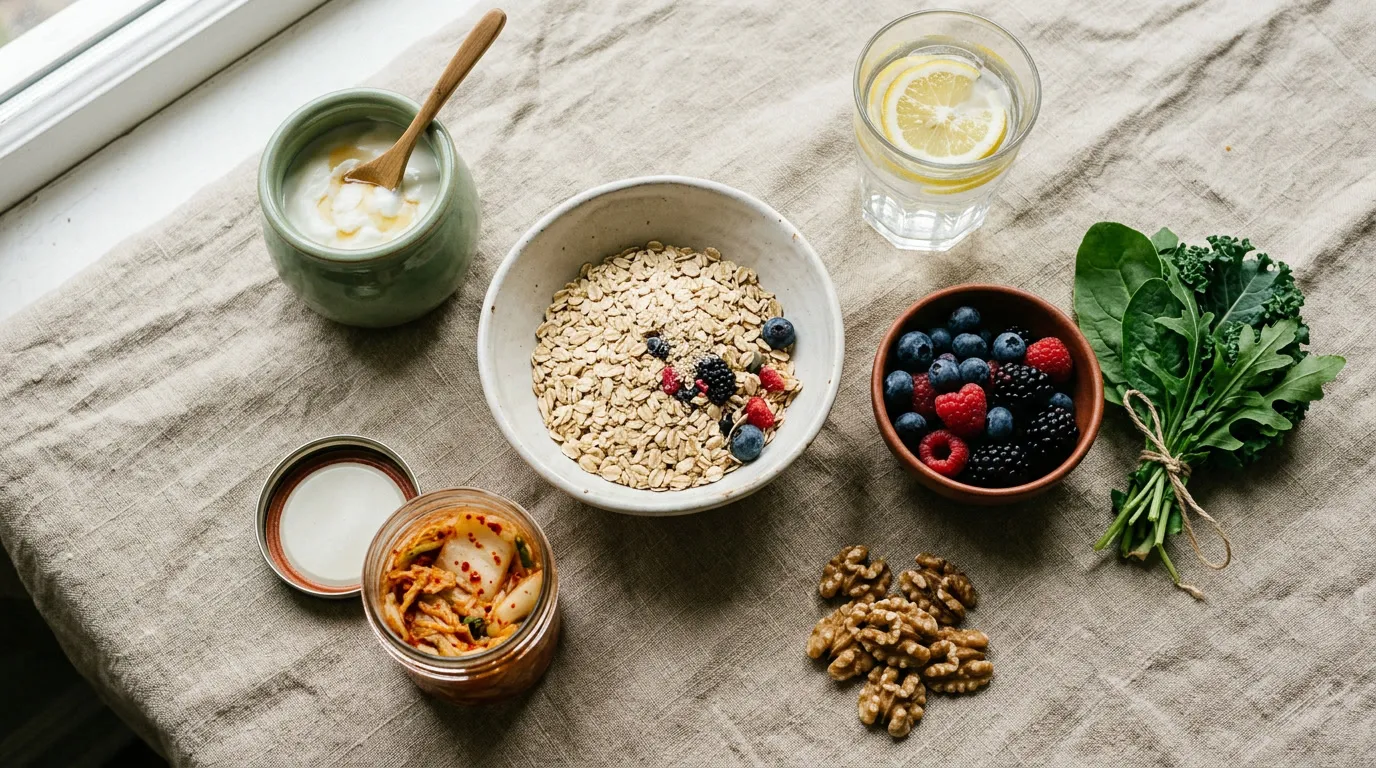
Increase your fiber intake. Dietary fiber is the primary fuel source for the beneficial bacteria in your gut — the ones that produce short-chain fatty acids and keep inflammatory processes in check. You don’t need a supplement for this. Oats, legumes, cooked and cooled starchy vegetables, and a wide variety of fruits all count. The key is variety and consistency, not hitting a specific daily gram target. Most women eating a Western diet are consuming far less fiber than their gut microbiome needs to maintain diversity.
Add fermented foods regularly. A 2025 review confirmed what several earlier studies suggested: fermented dairy products support skin health through immune-modulating and antioxidant mechanisms driven by live bacteria. Yogurt with live cultures, kefir, kimchi, and sauerkraut all count. You don’t need to eat them every single day for it to matter — a few times a week, consistently, is a reasonable starting point.
Consider a targeted probiotic. The clinical evidence here is specific enough to mention by name. In a 12-week trial, 110 adults aged 41 to 59 taking daily Lactobacillus plantarum showed measurable improvements in skin hydration, elasticity, and wrinkle depth. A separate 4-week trial with 600 women showed significant skin hydration improvements from Bifidobacterium breve combined with prebiotic fiber. Not every probiotic strain works the same way — what the research is telling us is that strain matters more than the label.
Reduce ultra-processed foods. Less glamorous than adding something new, but the evidence is consistent: ultra-processed foods reduce microbial diversity and feed the bacterial populations that drive systemic inflammation. This doesn’t mean eliminating everything you enjoy. It means that what you eat most of the time is what your microbiome mostly reflects — and the cumulative effect on skin is real.
Every woman’s body is different — and that’s not a cop-out, it’s actually important. These habits move the needle for most women over time. But if you have an autoimmune condition, take antibiotics frequently, or live with a chronic gut condition like IBS or IBD, your microbiome picture may be more complex than fiber and fermented foods can address on their own. In those situations, working with someone who can assess what’s actually happening in your gut is genuinely worth it.
How to Start Without Overhauling Your Entire Life
The version of gut health advice that asks you to eliminate six food groups, take seven supplements, and track every meal is not something most people can sustain. And honestly? It’s not what the research is actually asking for.

What the evidence supports is simpler. More fiber. More variety. Less processed food. More consistency. These aren’t exciting recommendations. They are cumulative ones — and cumulative is exactly what you want when you’re talking about skin aging, because the skin you’ll have in five years is being shaped by what happens consistently right now.
If I had to name one starting point for most women reading this, it would be fiber. Not a supplement — just more whole plants in the meals you’re already eating. Lentils in a soup. An extra handful of greens. An apple instead of a packaged snack. These are not dramatic interventions. They are the kind of steady, quiet changes that a gut microbiome can actually build on.
The skin timeline is slower than most people want it to be. You will not notice a difference in two weeks. But the clinical evidence is clear that at 8 to 12 weeks, measurable changes in skin hydration, elasticity, and barrier function show up — from gut habits alone. That is actually faster than most topical anti-aging treatments take to produce meaningful results.
I wrote about how specific gut-derived nutrients influence skin hydration and elasticity in more detail in this article — it connects directly to what we just covered, especially on the barrier side.
Frequently Asked Questions
Does gut health really affect how fast skin ages?
The connection is well-documented in peer-reviewed research. The gut microbiome regulates systemic inflammation, nutrient absorption, and skin barrier integrity — all of which influence how quickly skin shows visible signs of aging. A 2022 study in Life found that microbiome shifts in adults directly corresponded to reduced skin hydration, elasticity, and collagen support, independent of chronological age.
What does an unhealthy gut actually do to your skin?
An imbalanced gut activates inflammatory pathways that trigger MMPs — enzymes that break down collagen and elastin. At the same time, a compromised gut lining allows bacterial fragments into the bloodstream, driving a continuous low-level inflammatory signal that shows up as dullness, loss of firmness, and slower skin repair. It also reduces your body’s efficiency at absorbing the vitamins and minerals skin needs daily.
Can probiotics make a visible difference in skin after 30?
Clinical trials suggest yes, with the important caveat that strain and consistency matter. A 12-week trial with adults aged 41 to 59 showed real improvements in hydration, elasticity, and wrinkle appearance from one specific probiotic strain. Broader research on fermented foods also supports them as a meaningful dietary source of skin-supportive bacteria. Results are not immediate — they are gradual and compound over time.
What’s the single most impactful gut change for skin?
Increasing dietary fiber consistently has the broadest evidence base and the most accessible entry point. It feeds the beneficial bacteria that regulate inflammation and produce compounds that support skin barrier function. Reducing ultra-processed foods compounds this effect by removing the dietary inputs that deplete microbial diversity in the first place. Combined, these two changes address the inflammatory environment that drives most gut-related skin aging.
Do I need supplements, or can diet alone make a difference?
Many of the skin improvements studied in clinical research — including hydration, barrier function, and reduced sensitivity — were achieved through fermented foods and dietary fiber, not supplements alone. That said, specific probiotic strains like Lactobacillus plantarum show benefits in trials that are difficult to replicate through food sources alone. Diet is the foundation; a targeted probiotic can add to it, not replace it.
What shifted my thinking wasn’t reading about the gut-skin connection in an article — it was realizing that the skin I could see in the mirror was a lagging indicator. It was showing me what had been happening in my gut weeks and sometimes months before. Once that clicked, the habits stopped feeling like things I was doing for my skin and started feeling like information I was giving my body, with the skin just being the most honest place to read the response.
That’s not a guarantee of any particular outcome. Gut health is one piece of a larger picture, and I’d be doing you a disservice if I suggested otherwise. But it’s the piece most skincare content never gets to — and in my experience, it’s the one with the most room to actually move.
If you’re looking for a place to start on the gut-health side of this, I want to be transparent: the supplement I’ve been using is Neotonics Skin & Gut. It’s formulated specifically around the gut-skin connection and aligns with the probiotic and prebiotic research I find most compelling. I’ve listed it as my current top pick here if you want to take a look.
About Anne
Anne has been living with chronic psoriasis since her early twenties — and that’s what turned her into someone who reads dermatology studies on weekends and traces every skin flare back to what was happening three days before. She trains Muay Thai, eats with intention, and has spent years studying the gut-skin connection for one straightforward reason: surface solutions were never going to be enough for her skin, and she suspected the same was true for a lot of other women.
Sources
- How Microbiomes Affect Skin Aging: The Updated Evidence and Current Perspectives — Life, 2022
- Associations of the Skin, Oral and Gut Microbiome with Aging — Nature Aging, 2022
- The Gut and Skin Microbiome and Its Association with Aging Clocks — Int J Mol Sci, 2024
- Impact of Gut Microbiome on Skin Health: Gut-Skin Axis — Gut Microbes, 2022
- The Role of Probiotics in Skin Health and the Gut–Skin Axis — Nutrients, 2023
- Gut–Skin Axis: Microbial Dysbiosis and Skin Conditions — Microorganisms, 2021
- Scientists Explore How Skin, Mouth, and Gut Microbiomes Change with Aging — NIH / National Institute on Aging, 2022