There’s a very specific frustration that comes with psoriasis — the kind that settles in when you’ve done everything right. You’ve moisturized. You’ve avoided the products that sting. You’ve cut stress down as much as life actually allows. And still, you catch a glimpse of your arm in the wrong light and there it is again — the redness, the patches, the skin that won’t cooperate no matter what you apply to it. I know that frustration from the inside. I’ve lived in it for years.
For a long time, I treated psoriasis as a skin problem. And technically, it is — but that framing kept me looking in the wrong direction. I was searching for answers on the surface when the question was actually coming from somewhere much deeper: my gut. What I eventually learned — through a lot of reading, a lot of trial and error, and honestly more time than I would have liked — is that what you eat directly influences the internal environment that either fuels psoriasis flares or helps quiet them. That’s not a wellness trend. It’s increasingly supported by research in immunology and microbiome science.
This article is what I wish someone had laid out clearly for me: the specific link between your gut, your immune system, and those patches on your skin — and what you can actually do about it at the table, not just in the bathroom cabinet. No promises that this will fix everything. No single perfect diet that works for every body. Just the clearest picture I can give you of what the evidence points toward, and where it’s genuinely worth paying attention.
Why Your Psoriasis Isn’t Starting Where You Think It Is
Here’s the thing that changed everything for me: psoriasis isn’t really a skin disease. It’s an immune system disease that shows up on your skin.
What that means, practically, is that the visible patches — the redness, scaling, inflammation — are the end result of a chain reaction that begins much earlier, deep inside your body. And a significant part of that chain starts in your gut.
Your Gut Is Running Your Immune System
Most people don’t realize that roughly 70–80% of your immune system lives in your gut. Your gut isn’t just a tube that digests food — it’s basically headquarters for immune activity. The microbiome (the trillions of bacteria that live in your intestines) communicates constantly with your immune cells, telling them when to activate and when to calm down.
When your microbiome is out of balance — which researchers call dysbiosis — it can send the wrong signals. A 2024 paper in Frontiers in Cellular and Infection Microbiology found a consistent pattern in psoriasis patients: lower levels of beneficial bacteria like Akkermansia muciniphila and higher levels of pro-inflammatory species. That imbalance doesn’t stay neatly contained in your gut. It ripples outward — and for people with psoriasis, it ripples straight to the skin.
When the Gut Wall Develops Gaps
And this is where it gets interesting. Your intestinal lining is designed to be selective — it lets nutrients through but keeps bacteria, toxins, and undigested food particles out. When that lining is compromised — a condition called increased intestinal permeability, or what you might have heard called “leaky gut” — those things start slipping through into your bloodstream.
A 2025 study from Uppsala University found that 50% of psoriasis patients showed measurably increased intestinal permeability, with elevated blood markers that correlated directly with how severe their psoriasis was. What was particularly striking: the same immune cell profile found in inflamed psoriatic skin lesions was also present in the gut wall — suggesting the inflammation isn’t happening in two separate places, but is part of one connected immune response traveling through the body.
Think of it this way: your gut is sending out an alarm, and your skin is one of the places that alarm shows up.
Why the Standard Skincare Approach Only Gets You Part of the Way
When you’re dealing with psoriasis, the default path is usually the same. You start with moisturizers and over-the-counter creams. If those don’t work, you see a dermatologist and come home with a prescription — a topical corticosteroid, a vitamin D analogue, maybe a biologic if things are more serious. You might be told to manage stress, which is genuinely good advice, even if it’s frustratingly vague.
None of that is wrong. I want to be clear about that. Topicals can absolutely calm a flare when you need relief right now. Biologics have changed the picture entirely for women with severe psoriasis, and there’s real science behind them.
But here’s what most of these approaches have in common: they work downstream. They address the inflammation after it’s already arrived at the skin. They don’t reach the gut environment where a significant part of the immune signal is originating. That’s not a failure of dermatology — it’s just an acknowledgment that skin is what’s visible, so it makes sense that treatment has historically focused there. What the research is now clarifying is that for many women, the most durable results come from working on both levels at once.
What the Evidence Actually Points Toward — And How to Apply It
This is what I find genuinely exciting about where the science is right now: there are real, high-quality studies looking at diet and psoriasis. Not just patient surveys. Actual controlled trials with measurable outcomes.
The Mediterranean Diet and Real, Measurable Results
The strongest evidence I’ve come across is the MEDIPSO trial, published in JAMA Dermatology in 2025. Researchers put patients with mild-to-moderate psoriasis on a Mediterranean diet for 16 weeks — olive oil, fatty fish, vegetables, legumes, whole grains. The results were striking: 47.4% of the diet group achieved a 75% reduction in psoriasis severity, measured by a standardized clinical score. In the control group, that number was 0%.
A Mediterranean eating pattern works on psoriasis because it’s inherently anti-inflammatory — it reduces the same systemic immune signals that drive psoriatic activity. And it feeds beneficial gut bacteria, which helps restore the microbiome balance that psoriasis patients tend to be missing. This is a two-for-one that no topical cream can offer.
Alcohol Is Probably More Connected Than You Think
A U.S. national survey of psoriasis patients found that 53.8% of people who reduced alcohol consumption reported noticeable skin improvement — making it the single dietary change with the highest improvement rate in the entire survey. This makes biological sense: alcohol damages the gut microbiome, increases intestinal permeability, and puts significant strain on the liver’s ability to process inflammation. For a condition that is fundamentally driven by immune dysregulation, that chain of effects is hard to ignore.
Foods That Tend to Fan the Flames
The evidence on specific trigger foods is more variable — what drives one person’s flares doesn’t always affect someone else’s. That said, the same national survey identified a consistent pattern: sugar, alcohol, and tomatoes were the most commonly reported triggers, followed by gluten and dairy in certain subgroups.
Gluten deserves a specific mention. Psoriasis patients have higher rates of celiac antibodies, and there’s evidence that a gluten-free approach reduces symptom severity in those who carry these antibodies. This doesn’t mean everyone with psoriasis should go gluten-free — but if you’ve never been tested for celiac or non-celiac gluten sensitivity, it’s worth raising with your doctor.
What You Can Add, Not Just Remove
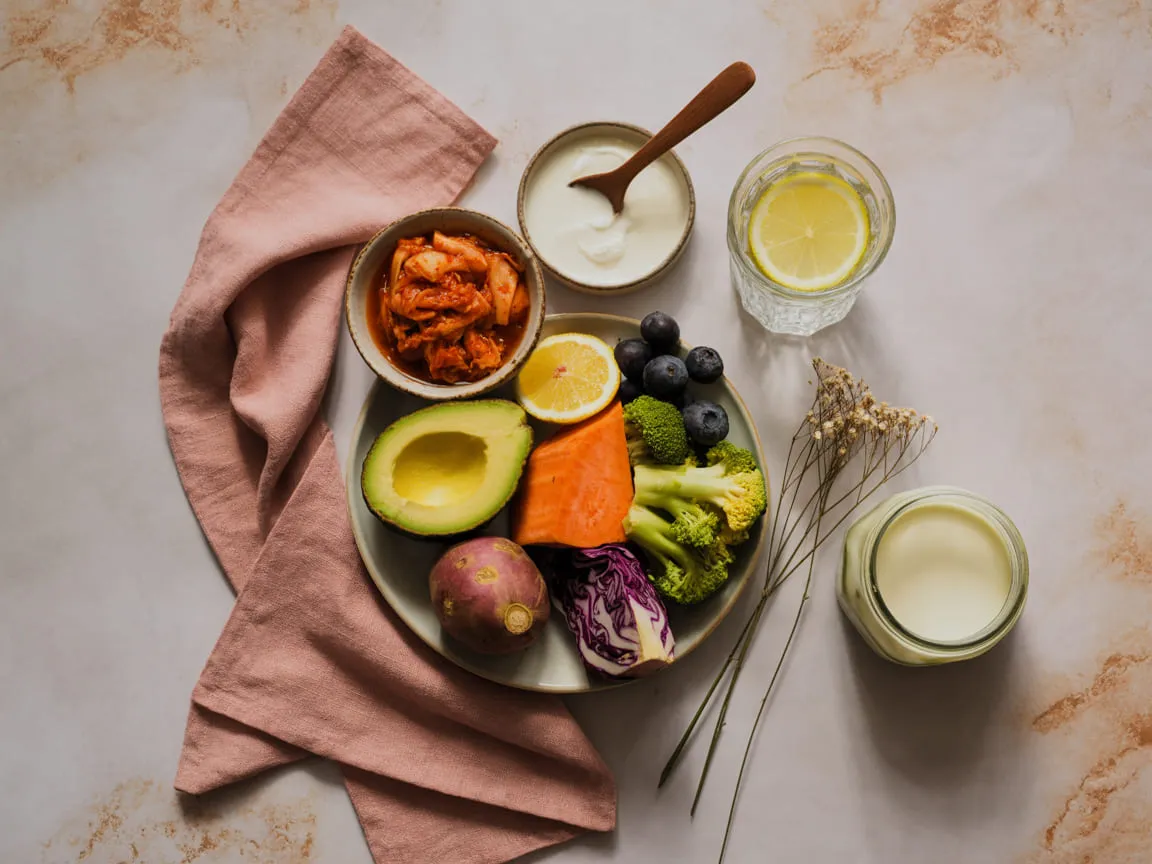
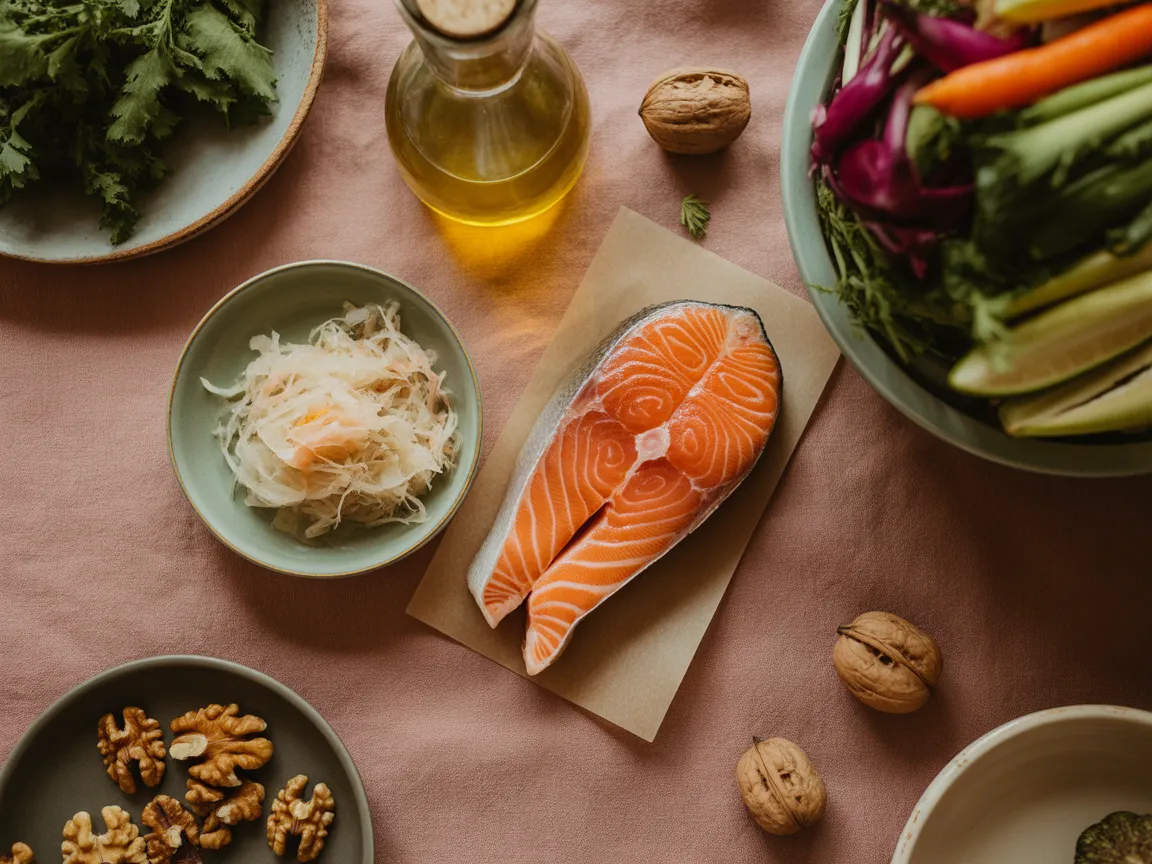
The gut-skin research consistently points toward fermented foods — yogurt, kefir, sauerkraut, kimchi — as a meaningful way to increase microbial diversity. Fiber-rich foods (legumes, vegetables, whole grains) function as fuel for the beneficial bacteria you’re trying to cultivate. Fatty fish like salmon and sardines bring omega-3 fatty acids with direct anti-inflammatory properties.
This is an additive approach, not just a restrictive one — and that distinction matters when you’re already managing a condition that affects so much of daily life. Adding tends to feel more sustainable than eliminating, and sustainable is the only kind of change that actually holds.
What This Means for Your Skin Specifically
Every woman’s body is different — and with psoriasis, that’s not a throwaway disclaimer. It’s actually important to hold onto. The same dietary change can have a dramatic effect for one person and very little effect for another, depending on your specific microbiome makeup, your genetic markers, how long you’ve been dealing with the condition, and what medications you’re currently on.
If you’re taking biologics or immunosuppressants, any significant dietary shift is worth discussing with your dermatologist or rheumatologist first. Not because diet isn’t relevant — it genuinely is — but because these medications interact with your immune system in specific ways, and your doctor needs the full picture to advise you well.
If you’re starting from scratch without those complexities, the evidence most consistently supports: less alcohol, more plants, more fermented foods, fewer ultra-processed foods. These aren’t dramatic overhauls. They’re directional shifts — and they reach a layer of the problem that no cream applied to your skin can touch.
A Note From Anne
I spent a long time believing my psoriasis was just something to manage, not something I could meaningfully influence from the inside. Learning about the gut-skin connection didn’t give me a cure — I want to be honest about that. But it gave me a framework for understanding what my body was actually doing, and that understanding changed everything: what I eat, how I interpret a flare, what I pay attention to between them.
Your skin isn’t broken. It’s communicating. And the more clearly you understand what it’s trying to say — and where the signal is actually coming from — the better equipped you are to respond to it.
Frequently Asked Questions
Can changing my diet actually improve psoriasis?
Yes — though the degree of improvement varies from person to person. The strongest clinical evidence comes from the MEDIPSO trial (JAMA Dermatology, 2025), where 16 weeks of a Mediterranean diet led to a 75% reduction in psoriasis severity in nearly half of participants. Diet works best as a complement to medical treatment, not a replacement — especially in moderate-to-severe cases.
How long does it take to see skin changes from dietary shifts?
Most clinical studies use a 12 to 16-week window to measure meaningful change. Skin turnover is slow, and rebuilding gut microbiome balance takes time. Some women notice reduced flare frequency within a few weeks; visible skin changes typically take longer. Consistency matters far more than perfection here.
Does everyone with psoriasis have gut issues?
Not everyone, but the overlap is significant. Research shows that 50% of psoriasis patients have measurably increased intestinal permeability, and many show microbiome imbalances. A subset also carries elevated celiac antibodies. Gut involvement isn’t universal — but it’s common enough to take seriously, especially if you also have digestive symptoms alongside your skin condition.
What foods should I avoid if I have psoriasis?
The most consistently reported triggers across patient surveys are alcohol, high-sugar foods, and for some women, gluten and dairy. Triggers are individual, though — keeping a simple food-symptom journal for a few weeks can help you identify your own pattern, which will be more useful than following a generic elimination list.
Is “leaky gut” a real medical concept?
Yes — though it’s often discussed imprecisely in wellness spaces. “Leaky gut” is shorthand for increased intestinal permeability, a clinically measurable condition where the gut wall becomes more permeable than it should be. In psoriasis research, it’s tracked via blood biomarkers like Claudin-3 and I-FABP. It’s not a fringe term — it’s a real, documented mechanism with direct connections to inflammatory skin conditions.